An older adult and young child sit together outdoors smiling and interacting in a peaceful natural setting.

Neurology

Your partner in brain health

You’ll find expert care for conditions that affect your brain, spine, and nervous system through UTMB Health’s experienced neurology team. Our specialists help you understand your symptoms, find answers, and feel supported throughout your care.

From headaches and memory loss to seizures, movement disorders, and complex neurological diseases, we provide advanced testing and the latest treatments tailored to your needs. With specialists in every area of neurology and a commitment to compassionate, personalized care, our goal is to help you achieve the best possible quality of life.

  Find a Specialist

 Frequently Asked Questions.

  • What conditions does UTMB Neurology treat?

    UTMB Neurology treats a wide range of brain, spine, and nerve conditions. Our specialists care for patients with memory problems, movement disorders, multiple sclerosis, epilepsy, seizures, stroke, migraines, neuromuscular diseases, and more. We also have a dedicated pediatric neurology team for children with neurological conditions.
  • When should I see a neurologist?

    You should see a neurologist if you have symptoms such as frequent headaches, dizziness, seizures, memory loss, tremors, numbness, weakness, or vision changes. If you have had a stroke or are at risk for one, a neurologist can provide specialized care.
  • What types of neurologists are at UTMB?

    UTMB has experts in several subspecialties of neurology:

    • General Neurology – for common neurological concerns such as headaches or dizziness
    • Memory & Cognitive Disorders – for Alzheimer’s disease, dementia, and memory loss
    • Movement Disorders – for Parkinson’s disease, tremors, and dystonia
    • Neuroimmunology – for multiple sclerosis (MS) and related conditions
    • Nerve and Muscular Disorders – for neuropathy, ALS, and muscular dystrophy
    • Epilepsy and Seizure Disorders – for seizure evaluation and treatment
    • Stroke and Vascular Neurology – for stroke care and prevention
    • Pediatric Neurology – for neurological conditions in children
  • What does it mean that UTMB is a Level 4 Epilepsy Center?

    UTMB is nationally accredited as a Level 4 Epilepsy Center by the National Association of Epilepsy Centers. This is the highest level of recognition for epilepsy care in the United States. It means our team provides the most advanced testing, treatments, and surgical options for people with epilepsy.

    Because UTMB is a Level 4 center, patients benefit from a team approach that combines neurologists, neurosurgeons, neuropsychologists, and rehabilitation specialists. This ensures that every aspect of epilepsy care, from diagnosis to treatment and follow-up, is available in one place.

A healthcare provider reviews brain imaging results with an older adult during a neurology consultation.

  Our Locations

Fluorescence-guided brain surgery means better outcomes for patients

In an effort to improve outcomes for patients diagnosed with gliomas—tumors that account for about three in ten of all tumors that start in the brain—members of the Neurosurgery team at the UTMB Health Clear Lake Hospital are now conducting fluorescence-guided surgery to remove these masses. 

headshot image of male physician wearing a blue blazer, glasses and a tie

This approach to brain surgery has been studied for years by UTMB neurosurgeon Dr. Pablo Valdes, who dedicated much of his PhD work to this science. Patients ingest a medicated drink that contains 5-aminolevulinic acid (5-ala) two to four hours before the start of anesthesia for their surgery.  

The medication then leads to an accumulation of a fluorescent marker, sometimes called a fluorophore, within the body. When viewed under a special light, the marker will emit violet-blue hues from the healthy parts of the brain anatomy, while the abnormal tumor will display reddish-pink.  

The contrast helps surgeons more easily identify what needs to be removed, versus what needs to stay.  

“The medicine helps us color tag the tumor and conduct color-coded surgery,” said Dr. Valdes, adding that the practice has been in use at the UTMB Galveston Campus for some time, before the recent expansion to the services offered in the Bay Area.  

While the description sounds simple, it’s a technology that’s allowing doctors to get within millimeters of critical areas when removing the potentially malignant threats.  

This means better chances of safely removing more tumor mass, resulting in a better post-op prognosis for patients.  
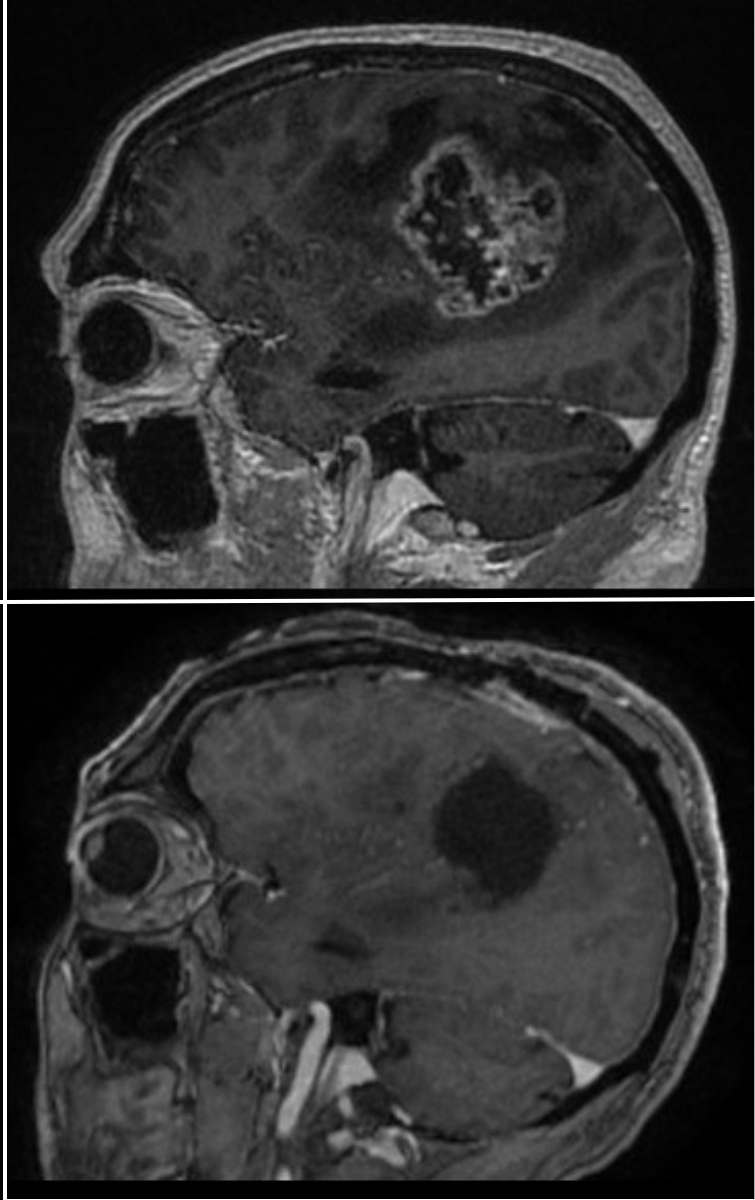
top image showcases MRI scan pre-surgery and the bottom image showcases the void left after a successful removal of 100% of the enhancing tumor

In fact, patients can live another one and a half to two years or more after surgery. A more traditional approach to brain tumor removal surgery often gave patients only a handful of months, Dr. Valdes explained.  

In a recent follow-up with a patient who was treated using this procedure, Dr. Valdes was happy to report that the individual was doing well nearly six months after having 100 percent of an enhancing tumor safely removed. 

Comparisons of pre-and-post-op images of this patient, showcase the surgery's success, evidenced by a large void where the tumor mass once occupied. 

Fluorescence-guided surgery is a common practice in other specialties, including breast and lung cancer cases, but its use in treating and removing brain tumors is newer and emerging.

“Certain agencies in the Texas Medical Center are not even doing it, so it’s pretty fantastic that we can do it here,” said Dr. Valdes of the leading-edge procedure.  

For more information on Neurosurgery and other Neurosciences services, please visit the Neurosciences website.